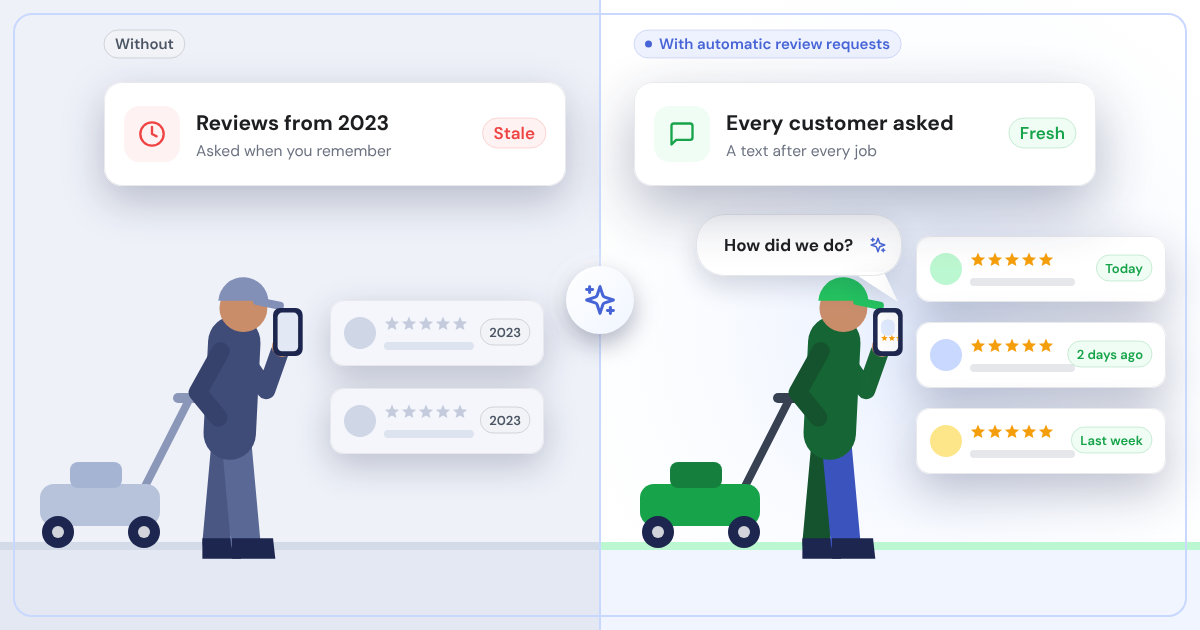
Your old reviews stopped counting
BrightLocal's 2026 Local Consumer Review Survey has a number in it that should change how you think about reviews. 74% of people say they only care about reviews from the last three months. 32% want to see ones from the last two weeks, up from 20% a year ago (BrightLocal).
So that pile of 5-star reviews from 2023 isn't doing much anymore. And people are pickier about the stars too. 31% will only use a business rated 4.5 or higher, almost double last year's 17%. 47% won't use a business with fewer than 20 reviews at all.
The other shift: 45% of people now use ChatGPT or another AI tool to find local businesses, up from 6% the year before. Google is still the biggest place people read reviews, but it slipped from 83% to 71%. When someone asks an AI "who's a good plumber near me," the AI is reading your reviews too, and it's reading the recent ones.
For a small shop, the takeaway is simple. You need a steady stream of new reviews, not a big pile of old ones. The problem is that "get more reviews fast" is exactly where people get into trouble right now.
Case study: what not to do
In May, the FTC and the State of Illinois went after Premium Home Service, a company that ran thousands of online listings for home repair businesses that didn't really exist. Plumbing, electrical, heating and cooling, garage doors. Calls went to call centers, and the FTC says tens of thousands of consumers got diverted away from real local companies. Part of the case: the company posted fake five-star reviews to drown out real one-star reviews (FTC). The defendants have asked the court to dismiss it, so it's not decided yet (DLA Piper).
You're not running a fake-listing operation. But the rule they're being charged under covers normal businesses too. The FTC's Consumer Review Rule has been in effect since October 2024, and civil penalties go up to $53,088 per violation (FTC). Last December the FTC sent warning letters to ten businesses. Six were property management companies. The common problems were things like lease discounts or gift cards for positive reviews, and asking family and friends to post (DLA Piper). That's not a scam ring. That's a regular local business trying to look good.
Google has its own penalties, and for a small shop they might hurt more. If Google decides your profile has fake or incentivized reviews, it can block new reviews for a while, unpublish your existing ones, and put a warning on your profile telling customers fake reviews were removed (Google). Picture that banner sitting on your profile during your busy season.
Case study: what works
The honest version is boring, and it works. Ask every customer, right after the job, every time.
Reputigo published a case study on a solo residential HVAC operator in the Southwest. Before, the owner asked for reviews by hand after jobs, which mostly got forgotten on busy days. They switched to an automatic text 24 hours after each job, with two reminders for people who didn't respond, and replied to every new review within a day. Over 90 days they went from 32 to 58 Google reviews, about 8 a month instead of 2, and the rating went from 4.1 to 4.6 (Reputigo). Podium says one of its customers, Arctic Air, saw 40% more reviews after turning on automatic review requests (Podium).
Both are vendor stories, the business in the first one is anonymous, and the second gives no baseline. So treat the exact numbers loosely. But the mechanism makes sense to me. Most happy customers will leave a review if you ask at the right moment and make it one tap. Most owners just don't ask consistently, because they're on the next job.
One detail in that HVAC case is worth pausing on. They used "private feedback routing" to catch unhappy customers. If that means unhappy customers get a call from the owner, great. If it means only happy customers ever get the Google link, that's where you need to be careful. More on that below.
What's real and what's still hype
Real: automating the ask. A text that goes out after every completed job, with a direct link to your Google profile and a reminder if nobody responds, is cheap to build and it runs forever. Replying to reviews matters too. 89% of people expect a business to respond, and 80% say they're likely to use one that responds to all of them (BrightLocal).
Real, but be careful: using AI to help write your replies. 50% of people are put off by templated replies. So AI is fine for a first draft, but the reply should mention the actual job, and someone should read it before it posts.
Not okay: AI-written reviews. The FTC specifically calls out AI-generated fake reviews (FTC). Same goes for "here's a sample review, just paste it." Don't.
The gray zone: asking only happy customers. The FTC says its rule doesn't specifically ban it, "but this practice could violate the FTC Act" (FTC Q&A). Google is stricter. Its policy says businesses shouldn't selectively ask for positive reviews, shouldn't offer incentives for any review, and shouldn't pressure customers into leaving one on the spot (Search Engine Roundtable). So no "$10 off your next visit for a review," and no tech standing there holding out a tablet. My rule: everyone gets the same ask, and anyone who had a bad experience also gets a call from you.
Where Solvr Labs fits
This is one of the first automations I set up for most clients, because it's small, it pays off, and it's easy to get right.
A review request that goes out after every job
With workflow automation, the trigger is the job being marked complete in the software you already use, like Jobber, Housecall Pro or ServiceTitan. A couple of days later, the customer gets a short, personal text with a direct link to your Google profile. Every customer gets it, not just the ones you think are happy. If someone writes back with a complaint, it goes straight to you instead of into the void. It can sit inside a bigger follow-up sequence too: thank-you text, review request, and later a maintenance plan reminder.
Since these are automated texts, I build them to follow the new opt-out rules that start November 25. Someone who replies "stop" stops getting texts.
Help replying without sounding like a robot
When a new review comes in, the system can draft a reply based on the actual job (the service, the tech, the neighborhood) and send it to you to approve or edit. You stay the one who posts it. That keeps you responsive without falling into copy-paste replies.
Making sure AI tools can actually see you
If 45% of people are asking AI who to hire, your reviews and business info need to be readable by those tools. That's what AI Agent Readiness covers: structured data on your site that spells out your services, service area, hours and reviews in a format AI and search engines read directly.
Not sure if reviews are your biggest leak
Sometimes it's the reviews. Sometimes it's the phone, or quotes nobody follows up on. The free operations assessment is a 30 to 45 minute call, and you get a written report within 48 hours with three to five specific places you're losing time or money. If reviews aren't the problem, I'll tell you. And if missed calls are, that's what Radar is for.
What to do this week
- Look at your last 90 days. Open your Google Business Profile and count reviews since late August. That's the number customers actually care about now.
- Clean up anything risky. Review discounts, gift card drawings, or asking relatives to post? Stop. If you've got a template that only sends the Google link to happy customers, change it so everyone gets it.
- Ask every customer, the same way. One short text after the job with a direct link. Even doing this by hand for a week will show you how many reviews you've been leaving on the table.
- Answer what's already there. Reply to your recent reviews, especially the bad ones. Keep it specific and calm.
- Use the slow season. Winter is a good time to set this up so it's running before spring gets busy.
If you want this running on its own, book the free operations assessment and we'll look at where it fits with the rest of your setup.
Sources
- Local Consumer Review Survey 2026, BrightLocal, Feb 11, 2026 (updated Oct 21, 2026)
- FTC and Illinois Take Action to Stop Deceptive Conduct by Company that Created Thousands of Business Listings of Fake Local Home Repair Businesses, FTC, May 11, 2026
- FTC's 2026 enforcement approach to fake reviews takes shape: Takeaways for companies, DLA Piper, Jul 27, 2026
- A warning letter (or ten) for businesses: comply with the FTC's Consumer Review Rule, FTC, Dec 22, 2025
- The Consumer Reviews and Testimonials Rule: Questions and Answers, FTC
- Federal Trade Commission Announces Final Rule Banning Fake Reviews and Testimonials, FTC, Aug 14, 2024
- Business Profile restrictions for policy violations, Google Business Profile Help
- Google Updated The Business Profile Review Policies, Search Engine Roundtable, Feb 20, 2026
- How a Residential HVAC Company Went from 32 to 58 Google Reviews in 90 Days, Reputigo
- AI Home Services Marketing Software That Books Jobs, Podium