Your texts are about to fall under new rules
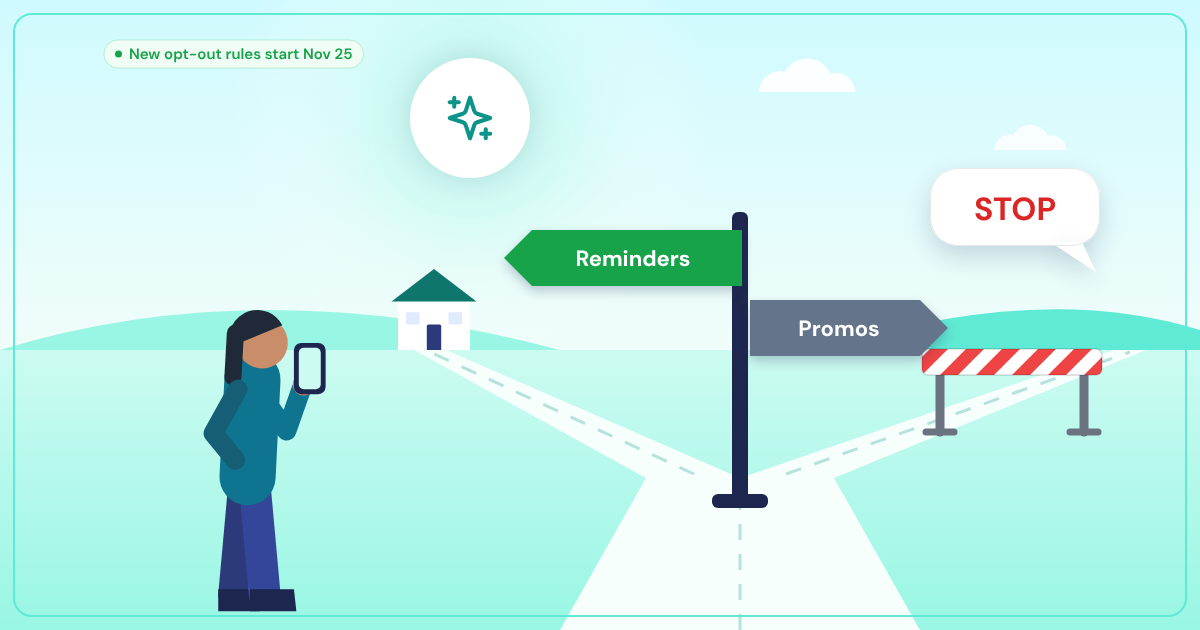
If your business sends automated texts, this one's for you. Appointment reminders, "on my way" texts, review requests, payment reminders, that fall tune-up special you blast to your customer list. On November 25, the FCC's new rules for how customers opt out of those messages take effect.
The order is FCC 26-67. It was released October 1 and published in the Federal Register on October 26, which started a 30-day clock. The FCC turned down a request for a 12-month runway, according to Nixon Peabody's summary. So you get about three weeks.
Most of the news coverage is written for banks and big call centers. But small service businesses text a lot now, because that's what customers want. In EZ Texting's 2026 survey of 959 consumers, 46% said they text a business always or most of the time, compared with 43% who call, and 65% prefer texts for appointment reminders. (EZ Texting sells texting software, so weigh that accordingly.) And the tools are piling on. ServiceTitan said on its September earnings call that revenue and call volume for its voice and SMS Virtual Agents each more than doubled in a single quarter.
More automated texts means more people replying STOP. Here's what changes when they do.
Quick note before we go further: I'm not a lawyer, and this isn't legal advice. I build these systems for a living, so I read the rule closely. If you send a lot of marketing texts, run your setup past a TCPA attorney.
Old rule vs. new rule
The last big update came in 2024. Most of it took effect in April 2025: customers could opt out by any reasonable means, and you had to honor it. A planned "revoke all" requirement, where one STOP would shut off every type of message from you, kept getting delayed by waivers. The latest waiver ran to January 31, 2027. The new order replaces it before it ever took effect.
Here's how the two compare:
- Scope of a STOP. Under the old plan, a STOP to any message could cut off all your robocalls and robotexts to that person. Now: if someone opts out of an informational message (a reminder, an outage notice, a payment reminder), you can treat it as applying only to that category. If they opt out of a marketing message, it still covers all your marketing.
- How they opt out. Before, any reasonable means counted. Now you can pick one official method: an automated voice or key-press opt-out on the call, a reply text with a standard keyword, or a website or phone number you set up for it. You have to clearly disclose that method on the call or in the text. If you don't pick one, "any reasonable means" still applies.
- The keywords. If you use the reply-text method, you have to honor seven words:
stop,quit,end,revoke,opt out,cancelandunsubscribe. You only need to show one of them in your message. - The deadline. Same as before: you have a reasonable time, no more than ten business days, to stop.
- The confirmation text. You can text back to confirm the opt-out, as long as it has no marketing in it. If you send it within five minutes, it's presumed fine.
All of that comes from the Federal Register text. The FCC also opened comments, due November 25, on whether to shorten the ten-day window, require two-way texting and bring back a revoke-all option. So this could change again.
On balance, it's mostly good news for small businesses. A customer who says STOP to your spring tune-up promo can still get the text saying your tech is ten minutes out. That's better for both of you.
Where AI comes in
The new order itself doesn't mention AI. It doesn't need to. In 2024 the FCC ruled that AI-generated voices count as "artificial" voices under the TCPA. So if an AI calls your customers back, those calls fall under the same consent and opt-out rules as a prerecorded call. Automated texts were already covered.
Why a small shop should care
Because the lawsuits are real and they're growing. WebRecon, which tracks consumer lawsuits, counted 2,096 TCPA suits filed through September 2026, up 13.4% from 2025. In September alone there were 191, and 68.6% of those were filed as class actions.
Class actions are what make this expensive. The TCPA allows $500 in damages per violation, and a court can triple that if the violation was willful or knowing. Multiply that by every text sent to every customer on a list and the numbers get ugly fast.
A real example: a roofing company
This isn't just a big-company problem. In Ford v. Farha Roofing, LLC (W.D. Missouri, No. 4:23-cv-00635), a customer sued two roofing companies and a media company. She claimed they sent advertising texts to cell phones without prior express written consent, and without all the required sender information. The defendants denied it. The case still ended in a $250,000 settlement.
That case was about consent, not opt-outs. But it's the same lesson: texts that feel harmless to the business, like a promo going to past customers, are exactly what these lawsuits target. And honoring STOP fast and correctly is the easiest part to get right.
What's real and what's still hype
Real today: catching all seven keywords automatically and stopping the next send within seconds, not ten days. Sending one plain confirmation text right away. Keeping separate lists, so an opt-out from promos doesn't kill your appointment reminders. And using AI to catch the opt-outs that aren't keywords. "Please don't text me anymore" or "take me off your list" isn't one of the seven words. A language model can flag it reliably, and if you haven't designated an official method, you probably have to honor it anyway.
Hype: any tool that claims it makes you "fully TCPA compliant" out of the box. Software can enforce the rules you set. It can't decide whether your tune-up text counts as marketing, and it can't create consent records you never collected. The category question matters more now, too. If your "reminder" also says "and ask about our 20% off duct cleaning," that's a marketing message. Nixon Peabody's advice is to keep promotional content out of informational messages entirely, and I agree.
Watch out for: texting tools set up years ago with only STOP and UNSUBSCRIBE in the keyword list. Check yours against all seven. Don't assume.
Where Solvr Labs fits
I build a lot of the texts this rule is about. Missed-call text-backs, 24-hour and 2-hour appointment reminders, review requests after the job, invoice follow-ups, seasonal tune-up reminders. So here's how I'd handle the change, depending on where you are.
If you already send automated texts: an opt-out audit
Book a free operations assessment and bring a list of every automated text your business sends, from every tool: your field service app, your phone system, your review tool, your marketing platform. It's 30 minutes with me, in English or Spanish, and within 48 hours you get a written report with the specific fixes. If texting is where your risk is, that's what we'll dig into: which texts are informational, which are marketing, which ones mix the two, and what to change in each tool. The report is yours to keep, whether or not you hire me to fix anything.
If you want it built right: workflow automation
With AI workflow automation, I build your texting on n8n and Twilio, connected to Jobber, ServiceTitan, Housecall Pro or whatever you use. For opt-outs, the setup I'd put in place looks like this:
- One list per category: appointment reminders, payment reminders, review requests and promos, so a STOP only shuts off what the customer said no to.
- All seven keywords handled, plus an AI check that flags plain-English opt-outs for you to review.
- A suppression check before every send, not a weekly cleanup, so nobody waits ten days.
- A confirmation text sent right away, with no promo in it.
- A log of every opt-out with the date and the message it replied to, in case you ever need to show it.
A single workflow like this is usually live in one to two weeks, and you test it with real scenarios before it touches a customer.
If you're about to add AI to your phones: Radar
Radar is my AI receptionist for trades. It answers your inbound calls 24/7, books jobs into your calendar or field service software, dispatches emergencies, and sends SMS confirmations and missed-call follow-ups. Answering a customer who called you isn't what these rules are about. The texts that go out afterward are. Every Radar setup is custom-configured to how your business works, so that's where we decide which of those texts are confirmations, which are follow-ups, and how opt-outs get handled. Full AI mode starts at $149/month plus a one-time setup fee, with no contract. If you'd rather keep a person on the phone, Copilot mode runs at about half the price.
Do this before November 25
- List every automated text you send. Every tool, every trigger, including the ones someone set up years ago.
- Label each one informational or marketing. If it's both, split it.
- Text STOP to your own business from a personal phone. Then try QUIT, REVOKE and "opt out." See what happens and how fast.
- Add an opt-out line to your templates, like "Reply STOP to opt out."
- Decide on your official opt-out method and use it everywhere. If you don't, any reasonable request counts.
- If you send promos to past customers, check that you actually have written consent for those numbers. That's what the Farha Roofing case was about.
If that list feels like a weekend you don't have, book the free assessment and we'll go through it together. Or if you're mostly worried about the phones, see how Radar works.
Sources
- Enhancing the Ability of Consumers To Control the Robocalls (FCC 26-67), final rule, Federal Register, Oct 26, 2026
- FCC scraps "revoke all" and lets businesses pick how consumers opt out, Nixon Peabody, Oct 7, 2026
- FCC Confirms that TCPA Applies to AI Technologies that Generate Human Voices, FCC, Feb 2024
- WebRecon September 2026 Stats, WebRecon, Oct 22, 2026
- 47 U.S. Code § 227, Legal Information Institute, Cornell Law School
- Ford v. Farha Roofing, LLC et al. settlement website, U.S. District Court, W.D. Missouri, No. 4:23-cv-00635
- 2026 Consumer Texting Behavior Report, EZ Texting via PR Newswire, Apr 14, 2026
- ServiceTitan Q2 earnings call highlights, MarketBeat, Sep 8, 2026