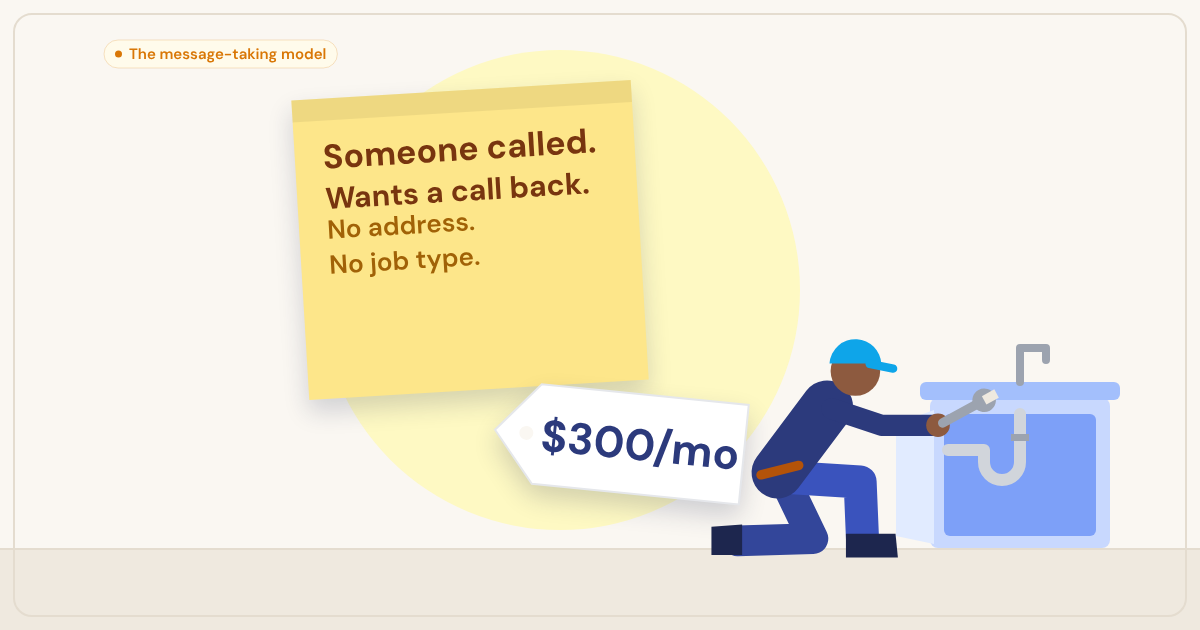
The $300/Month Message-Taking Problem
I just finished migrating another plumber off AnswerConnect last week. This guy was paying $340/month for what amounted to digital sticky notes. Someone would answer his calls, take a message, and email it to him. Then he'd call the customer back — if he saw the email in time.
Here's what happened with his last emergency call: Customer calls at 11:47 PM with a burst pipe. AnswerConnect takes the message, emails it at 11:52 PM. My client sees the email at 6:23 AM, calls the customer back, and gets voicemail. The customer? Already hired someone else and left a one-star review.
That's the traditional answering service model in a nutshell: you're paying hundreds of dollars for professional phone tag.
Why the Message Model is Broken for Field Service
Traditional answering services like AnswerConnect, PATLive, and MAP Communications were built for offices, not field service. They're designed around the idea that taking a message and passing it along is helpful. For a lawyer's office or insurance agency, maybe that works. For a plumber dealing with emergencies at 2 AM? It's useless.
The fundamental problem is delay. Every message is a delay. Every callback is a delay. Every "let me check and get back to you" is a delay. In field service, delays kill deals.
Here's what typically happens with traditional answering services:
- Customer calls — needs their AC fixed, it's 90 degrees outside
- Service takes message — "I'll pass this along to the technician"
- Email gets sent — maybe immediately, maybe in a batch later
- You see the email — if you're checking email, if it doesn't go to spam
- You call back — customer might answer, might not
- You schedule the job — if they haven't hired someone else yet
By the time you actually book the job, the customer has probably called three other companies. And whoever answers their own phone wins.
The Script Problem
Most traditional services use scripts. Generic, one-size-fits-all scripts that sound exactly like what they are: someone reading from a script who doesn't know your business.
I've heard recordings from these services, and it's painful. The operator asks for basic information but can't answer simple questions like "What do you charge for a service call?" or "Can you come out today?" Everything becomes "I'll have to pass that question along."
Your customers can tell they're talking to someone who has no idea what your business actually does. It doesn't inspire confidence when someone calls about a plumbing emergency and the person answering sounds like they've never heard of a water heater.
The Integration Gap
Here's the thing that really kills me about traditional answering services: they can't actually do anything. They can't check your calendar, can't book appointments, can't create jobs in ServiceTitan or Jobber, can't dispatch your on-call tech.
They're completely disconnected from your actual business systems. So even if they take a perfect message, you still have to:
- Manually check your calendar for availability
- Call the customer back to schedule
- Create the job in your CRM
- Alert your technicians
- Send confirmation to the customer
You're paying for the privilege of doing almost all the work yourself, just with an extra step added in the middle.
The Real Cost of Per-Minute Pricing
Most traditional services charge per minute, typically $1.50-$3.00 per minute after you hit your base minutes. Sounds reasonable until you do the math on actual service calls.
A typical service call inquiry takes 3-5 minutes if the operator is thorough. Emergency calls take longer because customers are stressed and want to explain the whole situation. So you're looking at $5-15 per call, plus your base fee.
But here's the kicker: longer calls don't mean better service. The operator still can't book the job or answer specific questions about your services. You're paying extra for them to say "I don't know, I'll pass that along" more times.
What Actually Works: The AI Advantage
I built Radar specifically to solve these problems. Instead of taking messages, it takes action.
When someone calls a Radar-powered business:
- AI answers instantly — no hold times, no "let me transfer you"
- Knows your business — pricing, services, availability, service area
- Checks calendar in real-time — can actually book appointments
- Creates jobs automatically — integrates with ServiceTitan, Jobber, Housecall Pro
- Dispatches emergencies — alerts on-call techs via SMS, Discord, or Slack
- Confirms everything — customer gets booking confirmation before hanging up
No callbacks. No phone tag. No lost emails. The customer calls, gets their question answered, books their appointment, and hangs up satisfied. You get a notification that you have a new job scheduled for tomorrow at 2 PM, with the customer's info already in your system.
That burst pipe call I mentioned earlier? With Radar, it would have been booked and dispatched before the customer hung up. The on-call tech would have been alerted immediately. The job would have been created in the CRM automatically. The customer would have gotten a confirmation text with the tech's ETA.
"The difference isn't just better service — it's a completely different business model. Traditional answering services sell you professional message-taking. Radar sells you an actual receptionist that can do the job."
Why This Matters More Than Ever
Customer expectations have changed. When someone calls an Uber, the car shows up without them having to call back to confirm. When they order food, they get real-time updates. But when they call a plumber, they get "someone will call you back"?
The businesses winning right now are the ones that can give customers what they want immediately. Book the appointment, confirm the time, send the details — all in one call.
Traditional answering services are stuck in a model that made sense in 1995. But your customers aren't living in 1995, and neither should your phone system.
If you're tired of paying for expensive message-taking services that don't actually help you book more jobs, check out Radar. It's time to upgrade from messages to actual results.