The Problem: Why Everyone Else Forces You to Choose
I've been building AI automation systems for service businesses for years, and one conversation keeps coming up: "The AI stuff is amazing, but I want a real person answering my phones."
It makes sense. Your receptionist knows your customers. They can read between the lines when someone calls with a "small leak" that's actually flooding their basement. They build relationships that turn one-time callers into loyal customers.
But here's what drives me crazy about the current market: every solution makes you pick a side. You can hire Smith.ai or Ruby for human answering services, or you can go full AI with platforms like ours. Human or AI. Never both.
That's a false choice. The real magic happens when you combine human intuition with AI automation.
How Copilot Mode Actually Works
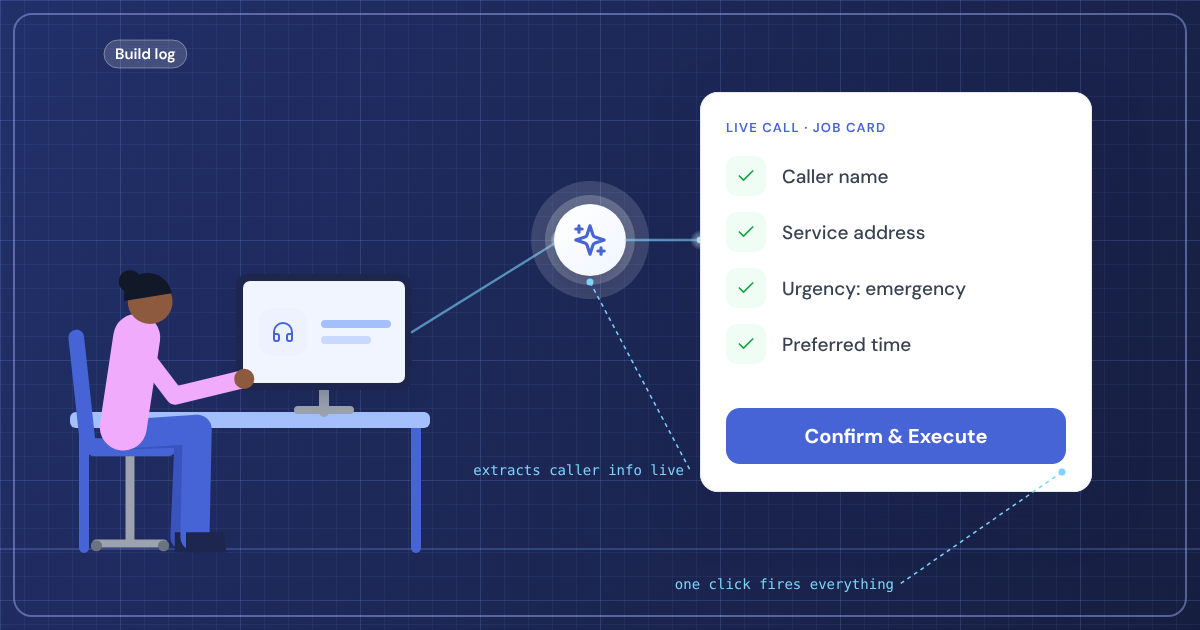
So we built something different. Radar's copilot mode puts your human receptionist on the call while AI works behind the scenes in real-time.
Here's what happens during a typical call:
The phone rings. Your receptionist picks up: "Good morning, this is Sarah from Johnson Plumbing, how can I help you?"
While they're talking, Radar is listening and working:
- Extracting caller info — name, phone, address, service type, urgency level, preferred scheduling
- Running confidence scores — green for solid info, yellow for unclear, red for missing
- Surfacing knowledge base answers — when the caller asks "Do you handle sewer line work?", Radar instantly shows your pricing and availability
- Suggesting follow-up questions — dynamic checklist that auto-clears as missing info gets filled in
- Looking up caller history — "This is Mrs. Chen, we installed her water heater last year, she always books Tuesday mornings"
- Queuing integrations — prepping the ServiceTitan job, calendar slot, Discord alert to your team, SMS to the on-call tech
Your receptionist sees all this on their screen. They focus on the conversation. Radar handles everything else.
When the call ends, your receptionist gets a clean summary dashboard. They can review what Radar extracted, edit anything that's wrong, enable or disable specific integrations, then click "Confirm & Execute." One button fires everything — job created in ServiceTitan, calendar updated, team notified, customer gets confirmation SMS.
No manual data entry. No sticky notes. No "did I remember to create that job?"
Why We Built This (The Real Story)
The idea came from watching our full AI mode customers. Radar handles calls perfectly in full AI mode — books jobs, dispatches emergencies, syncs everything. But some business owners just weren't ready to let go of human control.
I get it. When you're a small plumbing company and Mrs. Johnson calls about her kitchen sink, there's value in her talking to the same Sarah she's talked to for three years. That relationship matters.
But watching these businesses operate manually was painful. Sarah would take detailed notes during calls, then spend 10 minutes after each call typing everything into ServiceTitan, updating the calendar, texting the plumber, sending the customer confirmation. For a 5-minute call, she'd spend 15 minutes total.
That's not sustainable. Especially during busy season when call volume doubles.
So I started experimenting with real-time speech-to-text using n8n workflows connected to Claude AI. The breakthrough came when I realized we didn't need perfect transcription — we just needed to extract structured data while the conversation was happening.
The Technical Build
The stack is pretty straightforward:
- Twilio for call handling and real-time audio streams
- Claude AI for real-time conversation analysis and data extraction
- Supabase for storing caller history and knowledge base
- Next.js for the receptionist dashboard
- n8n orchestrating all the integrations (ServiceTitan, Jobber, calendar, SMS, Slack, Discord)
The tricky part was building confidence scores that actually work. Claude analyzes each piece of extracted data and flags anything uncertain. If someone mumbles their phone number, Radar marks it yellow and suggests your receptionist confirm it. If they mention "sometime next week" for scheduling, it flags that red and prompts for a specific day and time.
The dashboard updates live during calls. Your receptionist can glance at their screen and see exactly what follow-up questions to ask.
The Results: Doubling Receptionist Productivity
Our beta customers are seeing dramatic efficiency gains. One HVAC company went from their receptionist handling 30 calls per day to 55 calls per day — same person, same hours, nearly double the volume.
Why? Because copilot mode eliminates all the post-call work. No data entry, no manual job creation, no coordination with the field team. Radar handles all of that automatically.
"Sarah can focus on being Sarah — building relationships and solving problems. Radar handles all the computer stuff." — Mike, Johnson HVAC
The other huge win: error reduction. When humans manually enter call details, stuff gets lost or wrong. Addresses get typo'd. Urgency levels get missed. Jobs fall through cracks.
With copilot mode, Radar captures everything accurately during the call, then lets your receptionist review and correct before execution. Best of both worlds.
Pricing: Half the Cost of Full AI
Copilot mode costs roughly half what full AI mode runs ($149/mo). For businesses that want to keep a human receptionist but eliminate manual work, it's a no-brainer entry point.
Compare that to hiring additional staff when call volume grows, or the inefficiency of manual data entry eating up half your receptionist's day.
Plus, if you're already using Taskline for job management, we waive the setup fee entirely.
Human + AI: The Future of Small Business
I think copilot mode represents where most service businesses are heading. You don't have to choose between human relationships and AI efficiency. You can have both.
Your receptionist brings the personal touch, the local knowledge, the ability to read between the lines. Radar brings perfect data capture, seamless integrations, and elimination of manual work.
Together, they're unstoppable.
Ready to see how copilot mode could work for your business? Let's talk — I'd love to show you the dashboard and walk through exactly how it integrates with your existing tools.