The phone is still ringing. Just less, and later.
On October 1, Google started charging Local Services Ads advertisers for calls nobody answers. The notice, as quoted by PPC Land, says missed calls during business hours "will now be charged as valid leads if a user stays on the line for more than 20 seconds." Google's Ads Liaison clarified on X that follow-up calls from the same person within 15 days are only charged once (Search Engine Roundtable has the details).
So a missed call used to cost you the job. Now, if it came from an LSA, it can cost you the job and the lead fee.
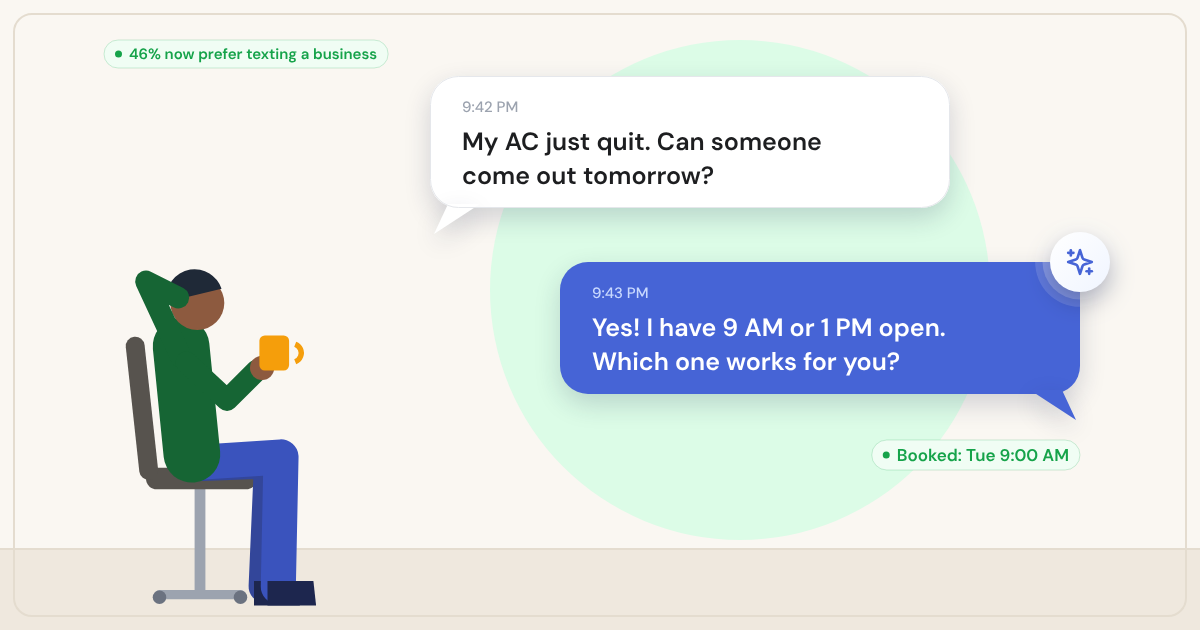
But here's what I think gets lost in that news. A lot of your customers aren't calling at all anymore. They're texting, filling out the form on your site, or messaging you after hours. And most shops are even slower on those channels than they are on the phone.
Customers moved to text. Most shops didn't.
EZ Texting's 2026 Consumer Texting Behavior Report (959 U.S. consumers, surveyed in January) found that text has passed the phone as the way people prefer to contact a business: 46% versus 43%. Nearly 70% expect a business to reply to a text within an hour, and 65% want appointment reminders by text. EZ Texting sells texting software, so they're not neutral, but the direction is hard to argue with.
It's even stronger with younger customers, who are now the ones buying houses and calling about water heaters. In weBoost's Good Call Survey, 47% of Gen Z said they feel anxious when someone calls them (32% of adults overall), 87% put texting in their top three ways to communicate versus 49% for calls, and 36% of Gen Z don't listen to voicemail. That survey is from 2020 and the Gen Z group was small (124 people), so treat it as a signal, not gospel. But think about what it means: if you call a 26-year-old back and leave a voicemail, there's a decent chance it never gets heard.
Businesses have known this for a while and mostly haven't acted on it. Back in 2019, Zipwhip found that 58% of consumers had texted back after a missed call from a business, while only 39% of businesses were texting customers at all. People were replying into a void.
Speed decides who gets the job
Here's the uncomfortable part. Even on the phone, Invoca's 2026 Home Services Benchmarks, built from real call data on its platform, found that only 52% of calls to home services businesses reach a person. For HVAC it was 34%, according to PPC Land's breakdown of the report. Plumbing did best at 74%.
Forms and texts are worse, because nothing rings. When Valve+Meter sent secret-shopper service requests to 466 HVAC, plumbing and home improvement companies, only 60% responded within five days, and a company that hadn't responded in the first six hours had a 75% chance of never responding (Pro Remodeler). That's from 2018, and I'd love a newer study, but I see the same thing when I test local shops today.
Meanwhile, Jobber's 2026 Home Service Trends Report found that over 55% of customers expect a reply within the hour and 28% expect one immediately, based on what more than 1,000 home service owners told them. The customer who texts you at 9:40 PM isn't going to wait until you finish your coffee the next morning. They texted three companies, and the first one to answer gets the job.
What it looks like when a shop answers in 30 seconds
The clearest example I found is Premier Heating and Air, an HVAC company in the Denver area. In Podium's case study, they put an AI rep on their leads that replies and books appointments straight into ServiceTitan. Their response time went from 4 to 5 minutes with their human team to about 30 seconds, and they report 3x more converted leads and more than double the lead capacity. The owner put it this way: "We're able to handle more than twice as much as we could before."
That's a vendor case study, so it's the best-case version. But notice what their "before" was: 4 to 5 minutes. That's already faster than most shops I talk to, and AI still made a big difference. If your current answer time on a web form is "tonight, after dinner," the gap is a lot bigger.
What's real and what's still hype
Real: AI can now read a text or a form, figure out what the person needs, check your calendar and offer real times, in plain conversational language. It can do that at 2 AM, and in Spanish. Big platforms are building it in, too: Jobber's Receptionist answers calls and texts and lets your staff jump into a text thread at any point.
Coming, but not here yet: customers sending AI agents to text you for them. TechCrunch just rounded up AI agents that live in your text messages, and some of them can already request quotes from household service providers on a user's behalf. I wrote last week about AI agents calling contractors. Texting is the same story, a bit earlier.
Hype: that you can turn on a bot and forget about it. A text reply that doesn't know your service area or your prices is worse than no reply, because it wastes the customer's time and makes you look sloppy. The AI is only as good as what it's trained on and connected to.
Where Solvr Labs fits
This is the gap I spend most of my time closing for small shops: every channel answered fast, in the customer's language, and booked into the tools you already use.
Missed calls and web forms: instant text replies
With AI workflow automation, a missed call triggers an AI-written text within seconds with your booking link, so the customer who won't pick up a callback still hears from you. When someone fills out your web form, the AI reads it, qualifies them and sends a confirmation text within about 10 seconds. A simple missed call text-back can be running in a few days. It's a one-time build fee plus a monthly retainer for ongoing support, and you approve every message template before it reaches a customer.
The calls that do come in: Radar
For the people who still call, Radar picks up in under 2 seconds, 24/7, in English, Spanish and 30+ other languages. It's trained on your services, pricing and service area, books the job into Google Calendar, ServiceTitan, Jobber or Housecall Pro, and texts your on-call tech when it's an emergency. That matters more now that a ring-out on an LSA call can show up on your Google bill. Full AI mode starts at $149/month plus a one-time setup fee, no contracts. If you'd rather keep your receptionist on the phone, Copilot mode runs at about half the price and does the data entry and booking for them.
Solo and just getting started: TaskLine
If you're a one-person shop, TaskLine is free forever. When you miss a call, TaskLine Agent picks up, gathers the details, checks your calendar and books the job, in English and Spanish. The AI suite only charges when it lands you a paying job. TaskLine users also get the Radar setup fee waived if they grow into it.
Test yourself tonight
Before you buy anything, find out how bad the leak is. It takes 10 minutes:
- Call your business after hours from a number you don't recognize. Hang up after 30 seconds. Time how long until someone texts or calls back.
- Text your business line. Does it even accept texts? Some office lines can't, and the customer never finds out.
- Fill out your own web form with a realistic request. Write down when you get a reply.
- Do it in Spanish if you serve Spanish-speaking customers. Arizona owners, I'm looking at you.
If any of those takes more than an hour, that's where your jobs are going. Book a free operations assessment and I'll walk through it with you. It's 30 minutes, in English or Spanish, and you get a written report within 48 hours with the specific fixes. Or if the phone is the obvious problem, go straight to Radar.
Sources
- Google LSA advertisers face missed call charges from October 1, PPC Land, Sep 25, 2026
- Google To Charge For Missed & Subsequent Calls On LSAs, Search Engine Roundtable, Aug 25, 2026
- 2026 Home Services Benchmarks, Invoca, Jul 2026
- Invoca packages AI agents as Google bills missed LSA calls over 20 seconds, PPC Land, Oct 6, 2026
- 2026 Consumer Texting Behavior Report, EZ Texting, Apr 14, 2026
- Blue Collar Strong: The 2026 Home Service Trends Report, Jobber, 2026
- Here are the top AI agents that can live in your text messages, TechCrunch, Oct 10, 2026
- Premier Heating and Air case study, Podium (undated, accessed Oct 19, 2026)
- Jobber Launches AI-Powered Receptionist to Answer Calls and Texts, Jobber, Aug 18, 2025
- Good Call Survey, weBoost, Apr 2020
- New survey: Consumers are texting to businesses that aren't set up to respond, MarTech, 2019
- A 5-Day Look at Response Times, Pro Remodeler, Dec 20, 2018