The AI money isn't where the ads say it is
Most of what I've written here lately is about the phone: missed calls, texts, AI agents calling contractors. That's still where a lot of jobs leak out. But when you look at what small business owners say AI is actually doing for them right now, the answer is less exciting and more useful. It's paperwork. Quotes, invoices and the books.
Jobber's 2026 Home Service Trends Report surveyed 1,050 home service owners. 52% use AI, and among them the top uses are quoting (54%) and invoicing (52%). Customer communication comes in at 35%. Quoting is also one of the biggest time sinks in the day: 37% of owners named it among their most time-consuming tasks, right behind running the jobsite and talking to customers.
Two newer surveys from this month point the same way:
- The New York Fed looked at 5,248 employer firms from the Fed's Small Business Credit Survey. 46% use AI tools. Among users, 77% saw no change in labor costs, and AI users were more likely to expect to hire, not less. (The authors are clear that's an association, not proof AI causes it.)
- Citizens' Q4 Business Pulse, reported by TechInformed, found that 94% of firms using AI across several functions cut spending on at least one outside service. 38% cut bookkeeping or accounting. And 44% of those firms expect to add full-time staff in the next three months, double the overall rate.
So AI isn't replacing the crew. It's replacing the evenings you spend typing estimates and the hours someone spends chasing payments. That matters because the crew is the hard part right now: in NFIB's September survey, 26% of owners named finding good labor as their single biggest problem, and 32% had openings they couldn't fill.
Why quotes and invoices, and why now
Here's the cash side of it. Intuit's 2026 Late Payments Report found that 59% of small businesses have invoices more than 30 days overdue, up from 47% a year earlier. Businesses with unpaid invoices are owed $17,700 on average, and 39% said a single late payment made it hard to cover payroll or bills in the past year. When owners were asked where AI could help most with money, the top answer was payment reminders (40%).
And the software companies have noticed. In the last six weeks:
- ServiceTitan made its Max AI package available to every residential contractor at Pantheon on October 6, with an invoice review agent in pilot and a collections agent "expected to come soon."
- Yelp announced Smart Lead Reply on October 20: an AI that answers quote requests, gathers project details and qualifies the lead inside the message thread. It rolls out in November at $30 a month for plumbers, cleaners, roofers, electricians and other eligible categories.
- Ramp launched Accounts Receivable in September, which drafts collection messages from your invoice details for you to review, and matches payments when they come in.
Case study: Team Rooter
The clearest real-world numbers I found come from Team Rooter, a residential plumbing company in Sun Valley, California. ServiceTitan published their results in a June press release after they adopted Max:
- Online booking conversion went from 61% to 66%.
- Revenue was up 18% year over year, and December 2025 was their best month in nine years.
- Average ticket was up 39% year over year.
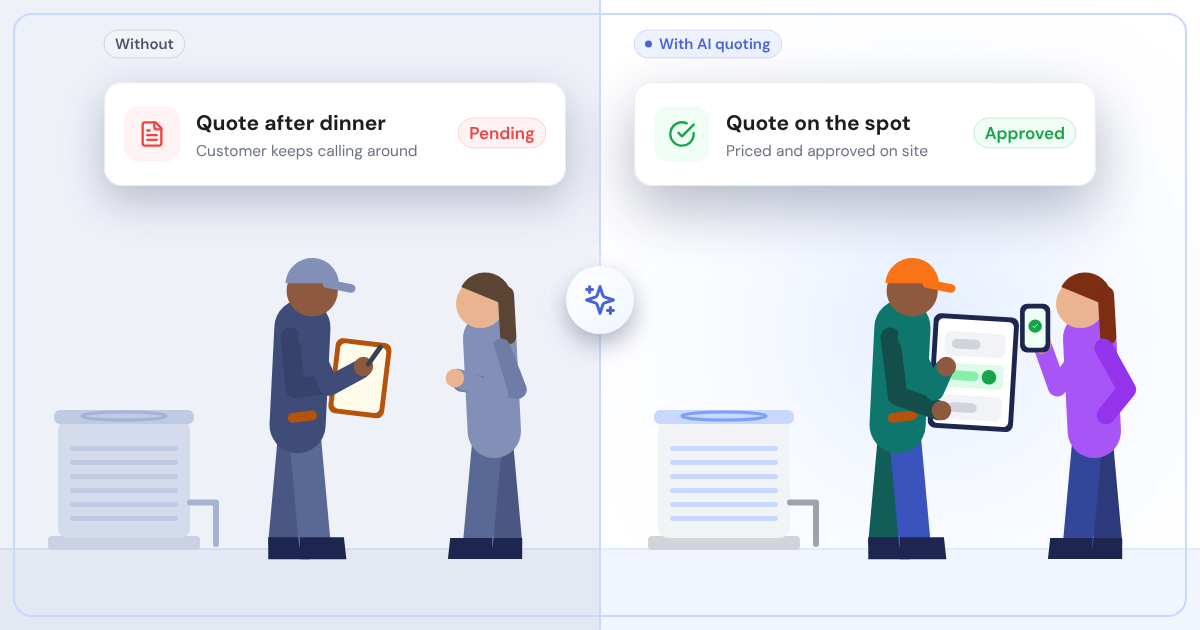
That last number is the one I care about. Booking more calls is nice, but a 39% bigger ticket comes from what happens in the driveway. Part of Max is an agent that builds customized quotes while the tech is still diagnosing the problem, so the customer sees real, priced options before the truck leaves instead of a number texted over the next night.
Two honest caveats. This is a vendor press release, and ServiceTitan itself says the results are customer-reported, not independently verified, and may not all be because of Max. And Team Rooter is on ServiceTitan, which a two-truck shop probably isn't. But the pattern is the useful part: the quote got faster and better at the same visit, and the ticket went up.
The other end: getting paid
On the collections side, the before-and-after stories are less dramatic and more relatable. Ian Mackey at SciComm Media, quoted in Ramp's launch, said a single late payment used to mean 20 or 30 emails back and forth. Jessica Bannister at Cam Cool Refrigeration, quoted on Jobber's invoicing page, says what she loves most is the automation: invoices get followed up periodically so she doesn't have to chase them herself.
Jobber also says businesses that accept online payments get paid four times faster. That's their own platform benchmark with no method published, so take it as directional. Intuit's data backs up the idea, though: 55% of businesses on net-30 terms have overdue invoices, versus 26% of businesses that ask for payment right away.
What's real and what's still hype
Real today: turning your notes or a voice memo into a clean, line-itemed quote priced from your own rate sheet. Sending good-better-best options so the customer picks instead of shopping around. Following up on quotes that went quiet, on a schedule. Generating the invoice the moment a job is marked complete, texting a payment link, and reminding people politely until they pay.
Not there yet: AI that prices a job on its own judgment. It needs your prices, your markups and your rules, or it will make things up. Same with collections: Ramp's tool drafts messages for a human to review, and ServiceTitan's collections agent isn't out yet. I think that's the right call. You don't want software sending a firm payment demand to your best customer without you seeing it.
Worth thinking about: your customer data. In a TD Bank survey covered by Forbes, 31% of owners named data privacy or security as their top barrier to using more AI. Fair. Know where your quotes and customer records live before you hand them to a new tool.
Where Solvr Labs fits
You don't need ServiceTitan to get the Team Rooter pattern. Quoting on the spot and getting paid without chasing are two of the most common things I build for small shops, and there are a few ways in depending on what you already use.
Solo or small crew: TaskLine
TaskLine is the free job management app I built for tradespeople and service freelancers. With Voice-to-Quote, you dictate what you see on the job site and TaskLine drafts a line-itemed quote, prices it from your rate sheet and sends it for your approval, before you start your truck. When a job is done, invoice follow-ups go out automatically, friendly at first and firmer when needed, and the AI never sends the final step without your OK. It also writes full proposals from a plain-English scope, in English or Spanish. TaskLine is free forever; the AI suite only charges when it lands you a paying job.
Already on Jobber, ServiceTitan or QuickBooks: workflow automation
If you don't want a new app, I connect the tools you already have with AI workflow automation. Two builds fit this post exactly:
- Auto invoicing after service: the tech marks the job complete in Jobber, the system generates the invoice, texts the customer a payment link, and follows up if it's still unpaid after 3 days.
- Estimate follow-up: a check-in 3 days after the quote, a value-add message at 7 days, and a final follow-up at 14. No more estimates that just die in the customer's inbox.
Most automations are live in 1 to 2 weeks. It's a one-time build fee plus a monthly retainer for monitoring and support, and you test everything with real scenarios before it goes live.
And the calls that start it all
The quote only happens if somebody books the visit. Radar answers your phone 24/7, books the job into ServiceTitan, Jobber, Housecall Pro or Google Calendar, and can auto-create invoices and customer records in QuickBooks from completed jobs. Full AI mode starts at $149/month plus a one-time setup fee, and the setup fee is waived for TaskLine users.
Start this week
You don't need to buy anything to find out how much this is costing you. Pull up your last 30 days and check:
- Quotes with no answer. How many did you send that never got a yes or a no? How many did you follow up on even once?
- Time to quote. For your last five estimates, how long between the visit and the customer getting a number?
- Invoices over 14 days. Add them up. Compare it to your payroll.
- Your rate sheet. Is it written down anywhere other than your head? AI can only price from what you give it, so this is step one no matter what tool you pick.
If those numbers sting, book a free operations assessment. It's a 30-minute call with me, in English or Spanish, and you get a written report within 48 hours with three to five specific places you're losing time or money and how to fix each one. No pitch. Or if you're a one-person shop, start with TaskLine for free and try Voice-to-Quote on your next job.
Sources
- Blue Collar Strong: The 2026 Home Service Trends Report, Jobber, 2026
- AI Adoption and Employment Expectations: Evidence from a Survey of Small Business Owners, Liberty Street Economics, Federal Reserve Bank of New York, Oct 8, 2026
- Small firms using AI across functions cut outside spending, TechInformed, Oct 8, 2026
- Small Business' AI Divide: A Minority Have Reaped Big Benefits, But Many Feel Unprepared, Forbes, Oct 12, 2026
- Small Business Economic Trends, September 2026, NFIB, Oct 2026
- 2026 Small Business Late Payments Report, Intuit QuickBooks, Jul 2026
- ServiceTitan Announcing New and Expanded Capabilities at Pantheon 2026, ServiceTitan, Oct 6, 2026
- ServiceTitan's Max Drives AI-Powered Growth for Contractors, ServiceTitan, Jun 24, 2026
- Do more on Yelp: fall product release, Yelp, Oct 20, 2026
- Ramp launches Ramp Accounts Receivable to help businesses get paid faster, Ramp, Sep 22, 2026
- Send Invoices Faster, Jobber (accessed Oct 26, 2026)