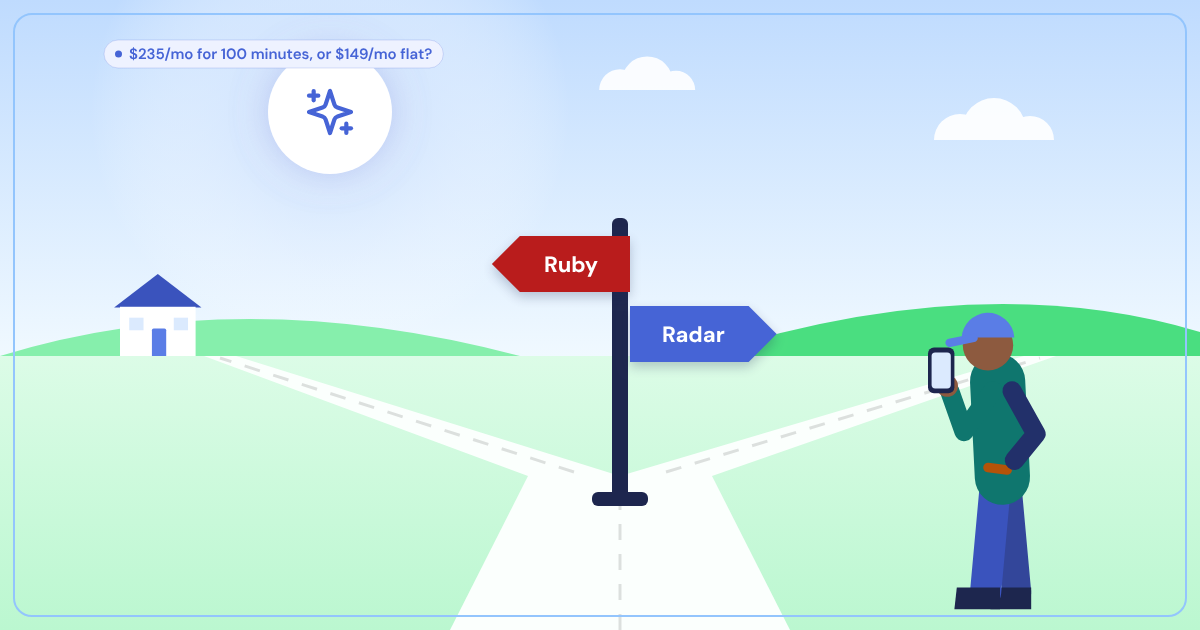
Ruby Receptionists Works Great... If You're Not a Tradesperson
I've been building phone automation systems for service businesses for years now, and I keep running into the same conversation. A plumber or HVAC tech will tell me they tried Ruby Receptionists for a few months, and while the service was "professional" and "polished," it just didn't work for their business.
The problem isn't that Ruby is bad — they're actually pretty good at what they do. But what they do is answer phones for law offices, medical practices, and other white-collar businesses where "taking a message" is usually enough.
That's not how trades work. When someone calls at 2 AM with a burst pipe, you don't want a human receptionist taking notes. You need that call dispatched to your on-call tech immediately, the job created in ServiceTitan, your team alerted on Slack, and the emergency response process kicked off automatically.
Ruby can't do any of that.
The Ruby Receptionists Reality Check
Here's what I learned after digging into Ruby's service for trade businesses:
Pricing gets expensive fast. Ruby starts at $235/month for 100 minutes, then charges per minute after that. If you're a busy contractor taking 20+ calls per day, you'll blow through those minutes in a week. Their higher tiers run $400-1640/month. Compare that to paying a full-time receptionist.
No field service integrations. Ruby receptionists can fill out web forms, but they can't create jobs in ServiceTitan, sync to Jobber, or book appointments in Housecall Pro. Every call still means manual data entry on your end.
Limited after-hours capabilities. Ruby offers 24/7 service, but it's still humans working shifts. During peak seasons or emergencies, you might get hold times. When you're dealing with water damage at midnight, every minute counts.
One call at a time. This is the killer for growing businesses. Ruby receptionists are human, so they handle one call at a time. If three customers call simultaneously during storm season, two of them are going to hold or hang up.
Generic training. Ruby trains their receptionists on general business communication, not the specifics of trades. They won't know the difference between a routine maintenance call and a genuine emergency. They can't quote your drain cleaning prices or explain why you charge more for weekend service.
Why I Built Radar Different
After seeing this gap over and over, I started working on Radar by Solvr Labs. The core idea was simple: what if your phone system actually understood your business and could take action, not just take messages?
Here's how Radar handles what Ruby can't:
Built for Trades, Not Offices
Radar knows the difference between a leaky faucet and a basement flood. It understands that "no hot water" is more urgent on a Sunday morning than a Tuesday afternoon. Every Radar instance is custom-trained on your specific services, pricing, service area, and emergency protocols.
When someone calls about a burst pipe at 2 AM, Radar doesn't just take a message. It books the emergency call, creates the job in your field service software, texts your on-call tech with the address and customer details, and logs everything automatically.
Actually Integrates with Your Tools
This was huge for me. I built native integrations with ServiceTitan, Jobber, Housecall Pro, QuickBooks, and pretty much every tool trades businesses actually use. Radar doesn't just answer your phone — it becomes part of your workflow.
A typical call flow looks like this: customer calls, Radar handles the conversation, extracts all the job details, checks your calendar for availability, books the appointment, creates the job in your system, alerts your team, and sends a confirmation text to the customer. All in real-time, while the customer is still on the phone.
Simultaneous Call Handling
Since Radar is AI-powered (using ElevenLabs for natural voice synthesis), it can handle multiple calls at once. I've seen clients take 15+ simultaneous calls during emergencies without anyone getting a busy signal or hold time.
Try doing that with human receptionists.
Two Ways to Work
Here's something none of Ruby's competitors offer: choice in how much automation you want.
Full AI Mode ($149/month) — Radar handles everything. Answers calls, has conversations, books jobs, dispatches emergencies. Completely autonomous.
Copilot Mode — Keep your human receptionist on the phone, but let Radar do all the backend work. It extracts caller info in real-time, surfaces answers from your knowledge base, suggests what to ask next, and queues up all the integrations. After the call, your receptionist just reviews and clicks "execute." No more manual data entry.
This is key because every business is different. Some want full automation, others want to keep the human touch but eliminate the busy work. Ruby forces you into one model. Radar adapts to how you want to work.
The Real-World Difference
I had a client switch from Ruby to Radar last year — a small electrical contractor in Phoenix. With Ruby, he was paying $400+ per month and still manually entering every job into ServiceTitan. His after-hours emergency calls were getting messy because the Ruby receptionists didn't understand his emergency pricing or which tech was on call.
Six months with Radar, and he's saving money while handling 40% more calls. Emergency dispatching is automatic. His ServiceTitan stays current without any manual work. He's booking more jobs because Radar can check his calendar and offer specific time slots instead of just saying "someone will call you back."
That's the difference between a general answering service and a system built specifically for trades.
Ruby vs Radar: The Bottom Line
Ruby Receptionists is a solid choice if you're a law firm or medical practice that needs professional humans to answer phones and take messages. They're polished, reliable, and good at what they do.
But if you're a plumber, electrician, HVAC tech, or any service business that needs your phone system to actually do things — book jobs, dispatch emergencies, sync with your tools, handle multiple calls, work at 2 AM — that's exactly what I built Radar to solve.
At $149/month with no contracts and setup fees waived for Taskline users, it's also a lot easier on the budget than Ruby's $400+ plans.
Want to see how Radar would work for your business? Let's talk. I'll walk you through exactly how it would integrate with your current setup and handle your specific types of calls.