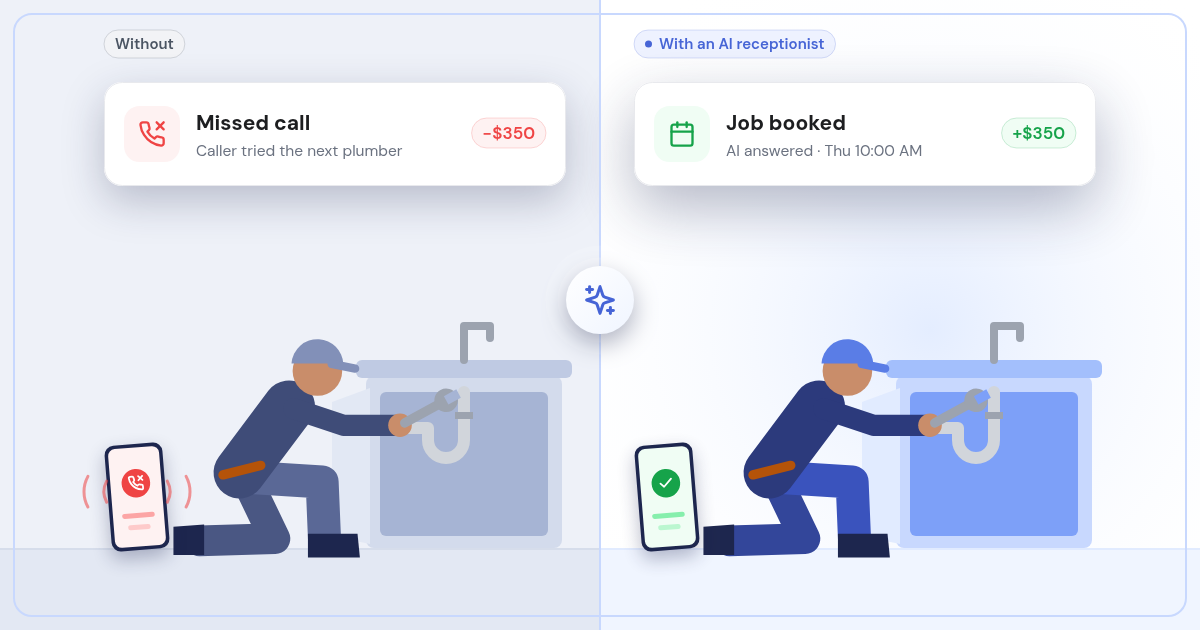
The $6,000 Monthly Leak You Probably Don't Even Notice
I was debugging a Supabase query for a plumber's scheduling system last week when he mentioned something that made me stop typing: "I swear my phone rings all day, but my booking calendar looks like Swiss cheese."
That got me thinking. We obsess over optimizing database queries and shaving milliseconds off API responses, but what about the bigger performance problem hiding in plain sight? The one that's probably bleeding thousands of dollars from your plumbing business every month.
Missed calls.
So I did what any developer would do: I ran the numbers. And honestly? The results made my stomach drop.
The Real Math Behind Missed Calls
Let me walk you through the data I pulled from industry reports and my own clients' Twilio call logs.
First, the baseline numbers:
- Average plumbing service call: $350 (HomeAdvisor, 2023)
- Emergency calls: $450-800 (nights, weekends, holidays)
- Percentage of inbound calls that go unanswered: 30-60% (varies by business size)
- Callers who reach voicemail and actually leave a message: 15%
- Callers who can't reach you and call a competitor instead: 75%
Now here's where it gets painful. Let's say you're a one-person plumbing operation getting 25 calls per week. Pretty typical for an established solo plumber.
The leak calculation:
- 25 calls/week × 40% missed = 10 missed calls/week
- 10 missed calls × 85% who don't leave voicemail = 8.5 lost opportunities/week
- 8.5 lost opportunities × 40% conversion rate = 3.4 lost jobs/week
- 3.4 lost jobs × $350 average ticket = $1,190/week
- $1,190/week × 52 weeks = $61,880 in lost revenue per year
And that's just regular calls. Emergency calls—the ones that come in at 11 PM on Saturday night when you're exhausted—those are worth $450-800 each. Miss five emergency calls per month and you're looking at another $27,000 in lost revenue annually.
"I never realized how much money was literally ringing off the hook. When I started tracking my missed calls, I almost threw up." — Mike, plumber in Phoenix who's now using Radar
Why Traditional Answering Services Miss the Mark
Most plumbers I talk to have tried answering services. The math seems to work: pay someone $3-5 per minute to catch your overflow calls. But here's what actually happens:
The per-minute trap: A typical service call booking takes 3-8 minutes. At $4/minute, you're paying $12-32 just to book a $350 job. The math works, barely. But then you realize the service doesn't know your pricing, can't check your availability in real-time, and books jobs you can't actually take.
The training problem: I've integrated with probably a dozen answering services for clients. Every time a plumber updates their pricing or service area, it's a 48-hour ticket process to update the scripts. By the time the answering service catches up, you've already lost jobs to incorrect quotes.
The handoff nightmare: Most answering services still use email or basic SMS to relay job details. No integration with your scheduling software. No automatic creation of jobs in ServiceTitan or Jobber. You spend 10-15 minutes manually entering what the AI could have done in real-time.
The AI Alternative: Actually Solving the Problem
This is exactly why I built Radar by Solvr Labs. Not as some flashy AI demo, but to solve this specific cash leak problem.
Here's how Radar changes the math:
24/7/365 availability: Every call gets answered. Your AI receptionist (you name them during setup—most clients go with "Sarah" or "Emma") picks up in 2 rings, sounds completely human thanks to ElevenLabs voice synthesis, and knows your business inside and out.
Real-time booking: While talking to the customer, Radar checks your actual calendar availability, quotes your real pricing, and books the job. By the time you get the Slack notification, the customer already has a confirmed appointment and you have a new job in ServiceTitan.
Emergency dispatch: Middle-of-the-night burst pipe? Radar knows which techs are on emergency rotation, sends them the customer details via SMS, and books the call at emergency rates. No missed revenue from sleeping through your phone.
The ROI Is Actually Insane
Let's go back to our example plumber losing $61,880 annually to missed calls. Radar's Full AI mode is $149/month—$1,788 per year.
Even if Radar only recovers 20% of those missed opportunities, you're looking at:
- 20% of $61,880 = $12,376 in recovered revenue
- ROI: $12,376 ÷ $1,788 = 692%
But here's the thing: in my experience with clients, Radar doesn't just recover 20%. It recovers closer to 80-90% because it never sleeps, never takes a break, and never forgets to ask the right questions.
One client in Denver told me Radar paid for itself in the first week. Three emergency calls at 2 AM that week—$1,400 in revenue he would have definitely missed.
Two Ways to Plug the Leak
Radar has two operating modes, depending on how you want to run your business:
Full AI Mode ($149/mo): Radar handles everything autonomously. Perfect for solo plumbers or small teams who want complete automation. The AI has the conversation, books the job, creates it in your management system, and notifies your team.
Copilot Mode (~$75/mo): Keep your human receptionist on the call, but let Radar do all the backend work. As your receptionist talks, Radar extracts customer info, surfaces pricing from your knowledge base, and queues up all your integrations. After the call, one click creates the job everywhere it needs to be. No data entry, no forgotten bookings.
The Copilot approach is huge for growing plumbing businesses. You keep the human touch customers love, but eliminate all the manual work that slows down your team.
Stop the Bleeding
Look, I'm not going to pretend every missed call is a lost customer. Some are price shoppers, some are outside your service area, some are just tire-kickers. But when 75% of people who can't reach you call your competitor, you're literally funding their business growth with your missed opportunities.
The math is pretty simple: if you're missing more than 2-3 calls per week, Radar pays for itself. If you're missing 10+ calls per week, it's probably the highest-ROI investment you can make in your business.
Want to see the exact numbers for your situation? I built an ROI calculator that factors in your average ticket size, call volume, and current miss rate. Check it out here and see how much that leak is really costing you.