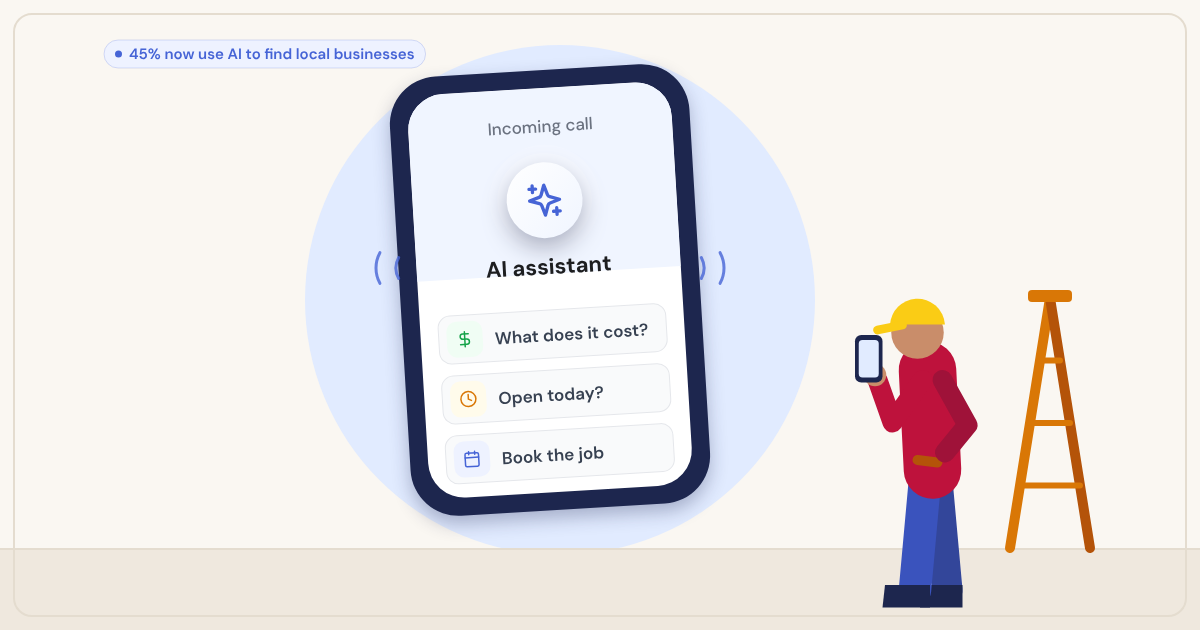
The next caller might not be a person
Two things happened this year that I think every small service business should know about, and most owners I talk to haven't heard of either one.
First, at Google I/O in May, Google said it was expanding agentic booking in Search to local services, and that "for select categories like home repair, beauty or pet care, you can ask Google to call businesses on your behalf." It was set to roll out to everyone in the U.S. over the summer. In the same post Google said AI Mode had passed one billion monthly users. Google's own how-to page for having Google call local businesses was updated on July 24: you search "near me," answer a few questions, and Google makes the calls and texts or emails you a summary.
Second, six days ago at its Pantheon conference, ServiceTitan launched Homh, a consumer platform that connects homeowners "and their AI agents" with selected ServiceTitan contractors. It works with ChatGPT, Gemini and Claude, and it books confirmed appointments straight into ServiceTitan.
Put those together and the picture is pretty clear. A homeowner with a leaking water heater doesn't have to call five plumbers anymore. They can tell an AI to do it. And the AI decides who gets the job based on what it can find out and who actually picks up.
Why a plumber or a cleaner should care right now
Customers already changed how they look for you. BrightLocal's 2026 Local Consumer Review Survey found that 45% of consumers used ChatGPT or other AI tools to get local business recommendations, up from 6% the year before. In the same survey, Google's share of review usage dropped from 83% to 71%. That's a big shift in one year.
Here's the part that matters for your phone. Google's Business Profile help page says its automated calls happen when "a customer wants to book an appointment" or "wants to confirm the price and availability of your products or services." When Google first tested this with pet groomers, a Google spokesperson told Search Engine Journal it only calls businesses that already show up in normal local results for that search. So the AI isn't calling everyone. It's calling the short list, and then it's asking three things: what does it cost, can you come, and can I book it.
If your phone rings out during a job, that call is gone. My read: a human customer might leave a voicemail. A piece of software running through a list of five businesses is just going to move to the next one. Jobber's 2026 Home Service Trends Report already found that over half of customers expect a reply within an hour and 28% expect one immediately. An agent doing the calling for them isn't going to be more patient.
What picking up every call actually does
The best real-world numbers I found come from the trades themselves. On episode #173 of the Owned and Operated podcast, co-host John Wilson talked about running AI call answering (Avoca) at his own home service company. He said it was saving him about $30,000 a month, and his call abandonment rate dropped from roughly 18-19% to about 7-8%.
On the same episode, Avoca's Tyson Chen described a Tennessee company that was booking 43% of calls with a national answering service and got to the low 90s in the first week on AI. He also said something I didn't expect a voice AI company to say out loud: fully AI answering books about 5% lower than a hybrid setup where a human and the AI work together, and he recommends hybrid for bigger shops.
These are vendor and customer claims on a podcast, not an audited study, so take the exact numbers with a grain of salt. But the direction matches everything I see when I set these systems up: the jobs were always there, they just weren't getting answered.
What's real and what's still hype
Real: Google's AI calling businesses is live in the U.S. for select categories, and home repair is one of them. ServiceTitan is booking real appointments from AI assistants for the contractors in Homh. More customers start with AI every month.
Hype: that most of your jobs will come from ChatGPT by next spring. Homh covers selected contractors, and Dispatch's coverage describes a curated network in 11 metros, with no fees or booking volumes disclosed. Dispatch also says it didn't test booking through the AI assistants itself. And the basics still decide who wins. In Jobber's survey, price (62%) and online reviews (51%) were the top reasons customers pick a provider. Only 14% said they value online booking.
So no, you don't need to panic or rebuild anything. You need the AI to be able to read your basics, and you need someone, or something, to answer when it calls.
Where Solvr Labs fits
This is the exact problem two of my services are built for.
AI Agent Readiness: get found and booked by AI
With AI Agent Readiness, I start with an audit: I ask ChatGPT, Claude, Gemini and Perplexity the questions your customers ask, send an agent to try to book you, and check what your site actually exposes. You get a plain-English scorecard. Then I fix what's in the way:
- Structured data (schema.org) that spells out your services, hours, service area and reviews in the format AI reads directly.
- An AI briefing file (
llms.txt) so assistants describe you accurately instead of guessing. - Service area and price ranges in plain text, not stuck in a flyer image an agent can't read.
- Consistent listings across Google Business Profile, Apple Maps, Bing, Yelp and your site.
- Booking and quote forms an agent can complete, with spam protection and the option to approve requests before they hit your schedule.
It works on the site you already have, it's a one-time project priced by the size of your site, and re-checks are an optional monthly plan. And I won't promise ChatGPT will recommend you. Nobody controls that. What I can do is remove the reasons it would skip you.
Radar: when the AI picks up the phone instead
If Google's agent calls you instead of using your website, Radar answers in under 2 seconds, 24/7, and handles multiple calls at once. It's custom-trained on your services, pricing, service area and availability, which are the exact three questions an agent asks. Then it books the job into Google Calendar, ServiceTitan, Jobber or Housecall Pro and texts your tech. Full AI mode starts at $149/month plus a one-time setup fee, with no contracts.
And if you'd rather keep a person on the phone, which is basically the hybrid setup Chen was describing, Radar's Copilot mode runs at about half the price. Your receptionist talks, Radar pulls the caller's details, suggests what to ask next, and fires the booking and alerts with one click when the call ends.
What to do this week
- Ask the AI about yourself. Open ChatGPT or Google's AI Mode and ask "who's a good [your trade] near [your city]?" See if you're named, and if what it says is right.
- Check your Google Business Profile. Hours, services and service area should match your website. In Business Profile settings, under Advanced settings, look at "Google automated calls and text messages." Make sure you haven't turned them off by accident.
- Put prices and service area in plain text. Even ranges like "water heater repair from $X" help an agent confirm you're a fit.
- Make sure every call gets answered. Nights and weekends included. That's where the agents and the emergencies both show up.
If you want help figuring out where you stand, book a free operations assessment. It's 30 minutes, and you get a written report within 48 hours. I'll ask the AI assistants about your business live and show you what they say. Or if you already know your phone is the leak, go straight to Radar.
Sources
- A new era for AI Search, Google, May 19, 2026
- Ask Google to call local businesses for you, Google, updated Jul 24, 2026
- About automated calls and texts from Google to your business, Google Business Profile Help
- Google Search Can Now Call Local Businesses Using AI, Search Engine Journal, Jul 16, 2025
- ServiceTitan Announcing New and Expanded Capabilities at Pantheon 2026, ServiceTitan, Oct 6, 2026
- ServiceTitan Launches Homh for AI Search and Contractor Booking, Dispatch, Oct 2026
- Local Consumer Review Survey 2026, BrightLocal, Feb 11, 2026
- Blue Collar Strong: The 2026 Home Service Trends Report, Jobber, 2026
- Owned and Operated #173: How Avoca AI is Shaping Home Services, Owned and Operated, Jan 23, 2026