The Reality Check AI Needs
I've been building AI automation systems for service businesses for over a year now, and I'm tired of the hype. Every day I see another "AI will replace everything" post, usually written by someone who's never actually deployed an AI system in production.
Here's the truth: AI is incredibly powerful for specific tasks, but it's not magic. After building systems for plumbers, cleaners, landscapers, and property managers using Claude AI, n8n, and the rest of my stack, I've learned exactly where AI shines and where it face-plants.
Where AI Falls Flat on Its Face
Relationship Building Is Still Human Territory
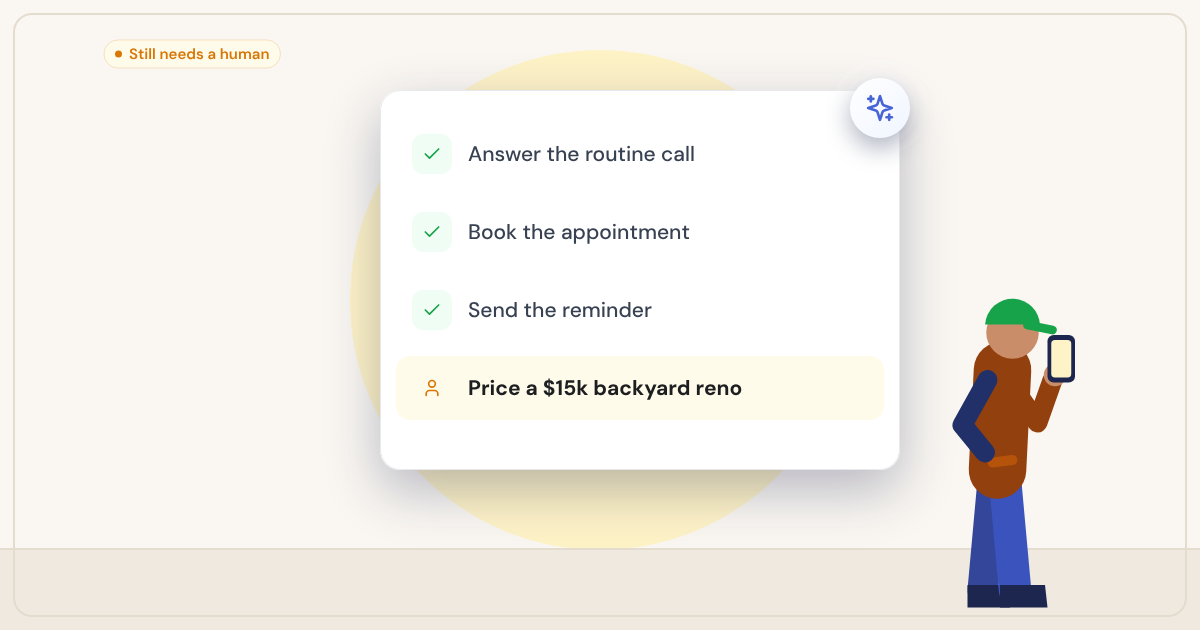
I built a lead qualification system for a landscaping company that could handle initial inquiries perfectly. It asked the right questions, collected project details, even scheduled estimates. But here's what I noticed in the data: prospects who had a real conversation with the owner before the estimate were 3x more likely to convert.
Why? Because when someone's dropping $15k on a backyard renovation, they want to trust a person, not a chatbot. AI can handle the logistics, but it can't build the rapport that closes deals.
On-Site Judgment Calls Require Human Eyes
A property manager I work with tried using AI to assess maintenance requests from photos. It worked great for obvious stuff - clearly broken faucets, damaged drywall, dead appliances. But it completely failed on anything requiring context.
Example: Tenant reports "weird smell in bathroom." Photo shows a normal-looking bathroom. AI response: "No visible issues detected." Human response after site visit: "That's a gas leak, evacuate immediately."
AI processes what it can see in data. Humans process what they experience in reality.
Novel Situations Break AI's Brain
I learned this the hard way with a plumbing company's emergency dispatch system. It handled 90% of calls perfectly - standard clogs, leaks, water heater issues. Then someone called about water shooting out of their electrical outlet.
The AI tried to categorize it as a plumbing issue and almost sent a plumber to what was clearly an electrical emergency. Now I have extensive fallback logic that routes anything even slightly unusual to humans.
The Hallucination Problem
Let's talk about AI's biggest flaw: it's confidently wrong way too often.
I was testing a customer service bot for a cleaning company when it told a client that bleach and ammonia make a "super effective cleaning solution when mixed." That's how you make chlorine gas. That's how you kill people.
The AI wasn't malicious - it just combined two facts (bleach cleans things, ammonia cleans things) without understanding the chemistry. This is why every system I build has guardrails:
- Hard-coded safety rules that override AI responses
- Human review queues for anything involving chemicals, electrical work, or safety
- Confidence thresholds - if AI isn't 95% sure, it asks for help
The "I Don't Know" Problem
Humans are generally bad at admitting ignorance, but AI is worse. It doesn't know what it doesn't know, so it guesses. Confidently.
I've seen AI customer service bots make up warranty policies, invent service areas ("Yes, we serve Mars!"), and hallucinate pricing that would bankrupt a business. The solution isn't better AI - it's better constraints.
What AI Actually Excels At
Before you think I hate AI - I don't. For structured, repeatable tasks, it's already better than most humans.
Data Processing and Pattern Recognition
AI can analyze thousands of customer service tickets in minutes and spot patterns humans would miss. I built a system that identified that 40% of "emergency" calls for one plumber were actually the same recurring issue with a specific apartment complex's old pipes.
24/7 Availability for Standard Tasks
AI doesn't sleep, take vacations, or have bad days. For appointment scheduling, basic FAQs, and initial lead capture, it's consistently competent in ways humans struggle with.
Scaling Personalization
AI can customize communications for hundreds of customers simultaneously. It remembers every previous interaction, adjusts tone based on customer preferences, and never forgets to follow up.
The Human + AI Sweet Spot
The best systems I've built don't replace humans - they amplify them.
Take the dispatch system I built using Supabase and Twilio. AI handles:
- Initial call screening and data collection
- Standard troubleshooting workflows
- Scheduling and route optimization
- Follow-up communications
Humans handle:
- Complex problem diagnosis
- Customer relationship management
- Unusual situations requiring judgment
- Final quality control
The result? Technicians spend more time fixing things and less time on paperwork. Customers get faster responses and better service. Everyone wins.
Building AI Systems That Actually Work
If you're considering AI for your business, start with these principles:
Define clear boundaries. Know exactly what you want AI to do and what you don't. Build hard stops for edge cases.
Plan for failure. AI will mess up. Have human backup systems ready. Monitor everything.
Start small and specific. Don't try to automate your entire business at once. Pick one repeatable process and nail it.
AI is a tool, not a replacement. The companies winning with AI aren't firing humans - they're making their humans more effective.
Ready to Build Something Real?
I'm not interested in selling you AI snake oil. But if you have repetitive processes eating up your team's time, structured customer interactions that could be automated, or data that needs processing at scale, let's talk about what's actually possible.
I'll tell you honestly where AI can help your business and where you still need humans. Because the goal isn't to replace your team - it's to free them up for the work that actually matters.
Let's have a real conversation about AI for your business - no hype, just practical solutions.