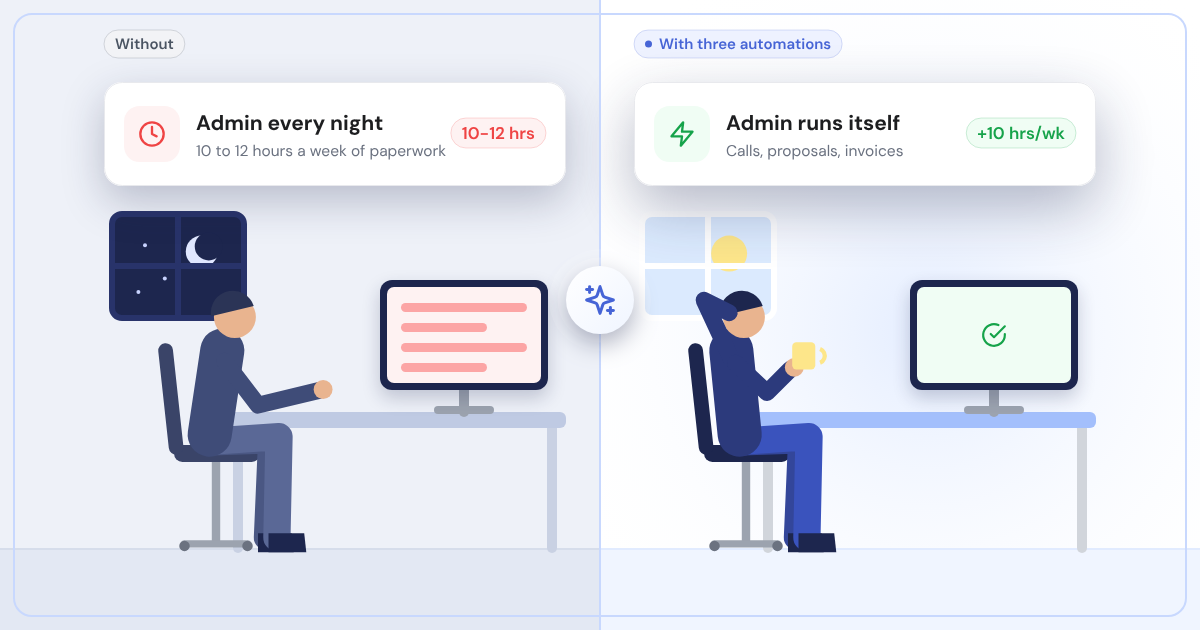
The Problem: Death by a Thousand Admin Tasks
Last month, I got a call from Mike, who runs a mid-sized plumbing company in Phoenix. Smart guy, great at plumbing, terrible at paperwork. He was spending 10-12 hours every week just on admin stuff — chasing missed calls, writing up proposals, and following up on unpaid invoices.
"I'm good with a wrench, not with a keyboard," he told me. "But I'm losing jobs because I can't keep up with all this other stuff."
Sound familiar? This is exactly the kind of problem AI automation can solve. Not the flashy ChatGPT stuff you see on Twitter, but boring, reliable workflows that just handle the grunt work so business owners can focus on what they do best.
Here's what I built for him, and how it saves him roughly 10 hours a week.
Automation #1: Missed Call Recovery
Mike was missing about 15-20 calls per week. In the plumbing business, people call when they're desperate. Miss that call, they're calling the next guy.
The Old Way
Mike would check voicemails when he got home, then try calling people back. Half the time, no answer. Then he'd forget to follow up. Lots of lost jobs.
The New Way
I built an n8n workflow that triggers whenever a call goes to voicemail:
- Twilio webhook catches the missed call
- Claude AI generates a personalized text message based on time of day and call context
- SMS goes out within 2 minutes with booking link
- Calendar appointment gets created in Google Calendar
- Discord notification pings Mike with job details
The SMS template is simple but effective: "Hi [Name], this is Mike from Phoenix Plumbing. Sorry I missed your call! I'm currently on a job but can help with [plumbing issue type]. Book a time that works for you: [booking link]"
Claude AI customizes the message based on the caller's number (returning customer gets different copy) and time of day (emergency after-hours calls get prioritized).
Time Saved: 3 hours per week. Mike used to spend 15-20 minutes per missed call trying to connect. Now it's automated, and his booking rate went from ~30% to ~65%.
Automation #2: Proposal Generation
Writing proposals was Mike's biggest time sink. He'd spend 45 minutes crafting each one, trying to sound professional while explaining technical stuff to homeowners.
The Process
After Mike finishes a consultation, he fills out a simple form in a Next.js app I built him. Just basic stuff:
- Customer info
- Problem description
- Proposed solution
- Parts needed
- Labor hours
The n8n workflow takes that data and:
- Sends it to Claude AI with a detailed prompt about Mike's business, pricing, and communication style
- Claude generates a professional proposal in Mike's voice
- Proposal gets saved to
Supabasewith a unique link - Mike gets a Discord notification to review
- Once approved, customer gets an SMS with the proposal link
The prompt engineering was key here. I spent time learning how Mike talks to customers, his standard pricing structure, and what objections come up most often. Claude now writes proposals that sound like Mike, just more polished.
The Results
Proposal writing went from 45 minutes to 5 minutes (just the form fill). Mike reviews each one before sending, but rarely needs to make changes. His close rate actually improved because the proposals are more consistent and professional.
Time Saved: 4 hours per week. Mike does about 6 proposals weekly, so that's 4 hours back in his pocket.
Automation #3: Invoice Follow-Up
This one was painful to watch. Mike would finish jobs, send invoices whenever he remembered, then basically hope people paid. No system, no follow-up. His average collection time was 45 days.
The New System
When Mike marks a job complete in his app:
Stripeautomatically generates an invoice- Customer gets an SMS with payment link
- If not paid in 3 days: gentle reminder text
- 7 days: second reminder with phone call option
- 14 days: final notice before collections
Each message is slightly different, generated by Claude AI based on the customer relationship and invoice amount. Long-term customers get friendlier reminders. Large invoices get phone call offers.
The follow-up sequence runs automatically through n8n, with all data stored in Supabase. Mike gets daily summaries in Discord but doesn't need to think about individual invoices.
Time Saved: 3 hours per week. More importantly, his average collection time dropped to 12 days, which massively improved cash flow.
The Technical Stack
Nothing fancy here, just reliable tools that work:
n8n: Workflow automation. Self-hosted on a $20/month VPSClaude AI: Text generation. About $30/month in API costsSupabase: Database and auth. Free tier handles everythingNext.js+Vercel: The simple web app Mike uses. Free hostingTwilio: SMS and call handling. ~$50/monthStripe: Invoicing and payments. Standard processing fees
Total monthly cost: about $100. Mike's ROI is roughly 40x considering the time saved and improved collection rates.
The Real Impact
Three months later, Mike's business runs differently. He spends his evenings with family instead of doing paperwork. His response times are faster, his proposals are more professional, and his cash flow is predictable.
"I feel like I hired a really good assistant," he told me last week. "Except this one never calls in sick and works 24/7."
That's the thing about good automation — it's not about replacing humans, it's about handling the boring stuff so humans can do what they're actually good at.
If you're running a service business and drowning in admin work, we should talk. This stuff isn't magic, but it might feel like it when you get 10 hours of your week back. Drop me a line and let's figure out what's eating up your time.